
Rare is that film with a definitive soundtrack in its most literal sense. The music on “Whiplash” tracks the film’s cinematic highs and lows, and it is key to manipulating the audience’s pulse, towards that applause at the end once the film’s greatness descends upon their consciousness. The movie ended on such an extremely high, WTF note that you can’t help but lay back on your seat and breathe out “that was so gooood”. And that’s exactly what it was. Kudos to wunderkid Damien Chazelle for writing and directing such a smart, wildly engaging movie that was at times slightly unnerving.
The movie opens on Andrew, played superbly by Miles Teller, practicing on his drum kit. When in walks music professor, Fletcher. The venerable character actor, JK Simmons plays the borderline-“abusive” (perspective shifts in this movie, so will mine) professor with a fearless intensity. They begin a strange back-and-forth akin to a mating ritual of sorts – if you like your significant other to be rude, profane, and incredibly overbearing. The film progresses into an eventual unraveling by both men, and that progression is both riveting and alarming. Both actors throw themselves into their roles, with Teller literally attacking a drum kit, and Simmons displaying an acting masterclass in both severity and subtlety. Teller’s Andrew literally transforms from shy, unsure freshman jazz drummer into an obstinate and entitled prick of a teenager. Both characters are unlikeable yet unassailable – both traits that the audience (myself definitely included) has somehow latched on to in the face of a gripping script, and thus turned them into a duo worth rooting for.

Despite the director’s admission that some aspects of the film have been “heightened” for drama, the well-grounded screenplay coupled with the fervent commitment displayed by the actors to their roles have given the film an air of credibility. Of course music artistes are fierce and competitive and eventual loners in a universe where success is measured by acclaim and perfection. And of course music teachers, like any other reputable coach or mentor, can dish out tough love on par with a drill sergeant. The belief that genius can somehow be earned is something that resonates with the Joe/Jane Everyman who is sitting in the theater and watching this movie.

The film's peak takes place in Carnegie Hall for a JVC concert. Fletcher intentionally mindfucks Andrew to the point of the latter crashing and burning in front of the eyes of a high-profile and discerning audience. And then, after walking offstage into the arms of his beleaguered father (played with both a tender and stern hand by Paul Reiser), Andrew returns to his stool and proceeds to play “Caravan” – that piece that launched his obsession for that elusive double-time swing and launched the dysfunctional relationship he currently shares with Fletcher. Then there’s this wonderful moment where he is a student no longer, and instead morphs into a bandleader as his father watches wide-eyed from the wings and Fletcher’s rage simmers underneath the stage lights. He tells the bass player “I’ll cue you in”. And he does. And the rest of the band follows suit, avoiding disgrace and saving face. And Andrew most beautifully mouths “Fuck you” to his former mentor.
Or was he?
For another beautiful scene takes place, as Fletcher recognizes that there is a MOMENT happening and he is quick to take advantage of it. “Sadist-enablers” is what I call both of them. They are both perfect and wrong for each other. The dysfunction is off the charts between these two, even though I understand their complex and acute need for each other to survive and thrive in the unrelenting professional world of jazz music. Discovering that Fletcher has finally found his Charlie Parker is as terrifying as it is mind-blowing.

Sunday, October 19, 2014
Film Review: "Whiplash"


Saturday, December 29, 2012
"The inevitability of time"... reversed by Bond
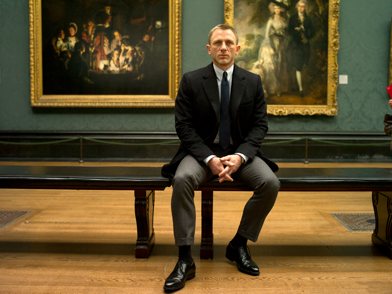
It's a big day for a cinephile like me - I just saw my very first Bond movie in the theater. And I couldn't have picked a better film to be "Bond-tized". Nearly every film critic I've read have nothing but praise for Skyfall. And on one lazy and wintry afternoon, I decided to hoof it to the cineplex and see it.
My dad is a huge Bond fan, and so are millions of others worldwide. Until today I had been completely immune to the icon's charms. Even when it modernized itself and kept up with the times and added more bang, I simply resisted it. I didn't know why. I wasn't worried about not knowing what the backstory was, because I knew there wasn't any. Bond was a standalone character, and was clearly on the side of good. The Bond films didn't need to exposit on previous films because they weren't in series. All you need to know was that Bond was an agent for the British intelligence, he was a ladies' man, his colleagues are named M (his boss) and Q (the weapons expert), and he liked his martini shaken. I think my disinterest stemmed from the fact that the films were always straightforward, and always ended happily for Bond. People will say that the journey is more important than the ending, but I wasn't a huge fan of filmic formulas. So I stayed clear from these movies for more than three decades.
Until Skyfall. When the franchise came into the 00's, the Bond character had gradually transformed into a brooding fellow unlike the campy ones of yesteryears. Daniel Craig's Bond had devolved into a devilish debonair agent, turning him into a complex character. This attracted me to it a great deal, and I expected a lot coming into it. I was not disappointed. While Bond films have always been mega-productions, the opening sequence in Turkey where he used a bulldozer to pursue his quarry on a moving train was pretty inspired. And jumping ahead a few scenes, what I really loved about this particular Bond film were the fight sequences.
The choreography and staging of all the fight sequences were excellent. One that I particularly enjoyed was the sequence on top of a Shanghai tower. The cinematography on this one was fantastic, with the blue lights and the neon jellyfish graphically going in and out of frame and helping to camouflage the players. And the fact that the actual fight was done in real time and in a single-camera setup was brilliant. There was no disguising the stunt. I actually wanted it to go on for longer because the choreography was really good. Kudos to the person who choreographed the fight. And of course, to Roger Deakins for making it all look so bloody good. I want him to win an Oscar for this one. He'll be in a competitive category, but I want him to take it all.
I also enjoyed the Aston Martin DB 5 being recalled back to duty. (And thanks to Top Gear, I knew instantly what a wonderful nugget that was for Bond fans. I wasn't a Bond fan to begin with and yet I got so excited when I saw the car.) I even loved the inside joke about the ejector seat button hidden in the stick shift. And good for the writers to finally give M something substantial to do other than phoning orders from the home office. Dame Judi is such a badass. (And I loved that her plucky ceramic British bulldog survived a bomb blast. And even outlived its owner *sniff*)
One thing I'd like to point out was the heavy-handed way they carried out the theme. That Bond was "old", and past his prime. Even M was on the way out, and Q has been replaced by a young 'un (Ben Whishaw is adorable though). Heck even J.M.W. Turner's "The Fighting Temeraire" gets a cameo and nearly clunks us over the head with it. But I love how they use this theme to an advantage - that of Bond relying on old-fashioned persistence and muscle and guile, on a straight razor to shave, on his old Aston, on radio transmitters, on an old-timey hunting knife, and on going back to the ol' Skyfall homestead. (So Bond is Scottish? He doesn't sound like one.) I wish he was still a standalone character with no back story or family issues that we know of. Instead, he turned out to come from a pretty wealthy family, and knew how to hunt. It feels as though the Bond franchise's turning 50 felt its age, and the producers had to stick that in. But ultimately, it was able to weave the theme tightly into the story, and with the way it ended, it was a very wise and understandable decision. And it made Bond seem more human and relatable.
As a Bond film, the fact that it gave Bond a personal history was one of the things it deviated from any expectations I had about the material. (Though Fleming readers will know that Bond does have a personal history; the movies just don't delve into it until recently.) And there were others. The Bond Women were kept mostly on the fringe, away from the main conflict (in fact, I'd say M figured to be the most central Bond Girl in this film). The bulk of the film was set in familiar London/UK, not an exotic location at all. (Though you can say that the Scottish highlands can substitute for one, with its dreary and mysterious expanse.) Gone were the exploding pens and the cartoony villains. (Though Bardem's Silva was fantastic, and displayed subtle camp when he shows himself to Bond for the first time.)
I think the one part I loved the most, and will anticipate moving forward (if I decide to see future Bond movies) is the new M. I have always been a fan of Ralph Fiennes, so I was really glad that his character grew from a government administrator bent on modernizing MI6, to becoming an agency head who can see past the bureaucracy. His firsthand experience in a shootout at Parliament helps hasten his character development and gives him the requisite "field experience" to gain his agents' respect (Bond, most of all). By the end of the film, you are fully convinced that he would make a good M, and would have 007's back.
I'm happy I made the decision to see this film. People have said this may be the best Bond film in the series, and I could see why they would say that. As a first-timer, it's shattered some of my preconceptions about the franchise, and manages to move it's 50-year old self into a new era. Not bad for an old-timer.
Jump...
Wednesday, July 29, 2009
The one Harry Potter film I didn't like

As Ron would say, I must be “barking”, but I’m one of those in the minority who didn’t love the sixth Harry Potter movie. Don’t get me wrong. I love love LOVE Harry Potter. I love the sixth book. But I’m afraid the movie doesn’t hold a candle to the richness, the depth, and the complexity of JK Rowling’s writing. I blame Kloves and Yates for cinematically "mangling" such a great book. I was hoping to love it, I really did. I even watched it a second time to try to figure out what I didn’t like about it, or to see if I can change my mind about it. But it didn’t.
One of the film’s major offenses was in terms of characterization. Now I admit to not loving all the characters in Rowling’s Potterverse, but I love the books enough to want to see them all cared for and characterized in a truthful manner. While most of the major characters were safe in terms of characterization (even Professor Snape's character was all-too truthfully "revealed" with the addition of a previously unwritten scene with Professor Dumbledore), some weren’t safe from Kloves’ screenplay. Most telling was Ginny’s. OOTP failed to present her as the best spell-caster among the Weasleys, and HBP failed again (why was she in the Slug Club?). The film showed her relationship with Dean Thomas, but it failed to show HOW that relationship ended. Instead, it showed her carrying a torch for Harry, which, granted, she always has done. But what the script ended up doing was portray Ginny as some sort of a fickle girl who found it easy to go from one boy to another. Which I found rather unfair especially since JK Rowling wrote her with such sincerity that I found her compelling even though she was my least favorite Weasley.
And while they did an adequate job painting Snape as the person that he would become by the end of the series, they didn’t do as adequate a job at depicting him as the Half-Blood Prince himself. They didn’t show Snape being as informed of Harry’s Potions brilliance, even though he saw Harry use the Sectumsempra spell. I am frankly amazed that Snape was able to make that leap about his old Potions book.
Another instance where characterization was fully lacking was with Fenrir Greyback. Did they establish he was a werewolf? Also, Kreacher. The House-elf, along with Grimmauld Place, failed to make another appearance (or even a mention), which makes me wonder how on earth they would be able to tie together the events in the seventh book. And the scene where Luna discovers Harry beneath his Invisibility Cloak due to the Wrackspurts surrounding him was totally made-up and annoyed me. While Luna is not entirely “loony”, and I suppose anything is possible in the Wizarding World, it must be said that Luna’s philosophy is supposed to be at odds with Wizarding reality (which is why they are on the “fringe” of magical society). So for the film to actually depict Wrackspurts as true – well, I got confused and annoyed, quite frankly. And it wasn’t even a case of building Luna’s character for the seventh movie, since she gets quite a bit of screentime here. I guess it was because they shaved off the “Tonks is in love and depressed” storyline that they had to find another way for Petrificus Totalused Harry to be found – and in so doing, basically confirmed the Lovegoods’ beliefs, but added themselves a potential headache in having to explain another relationship in the seventh film (although I could have sworn I heard Tonks use a term of endearment towards Remus at one point – or it could be I was just wishing too hard).
Another offense was the lack of continuity among the scenes. The scene after Dumbledore asks “too much of Harry” again was suddenly that of Dumbledore (and Snape) in the Astronomy tower and Harry arriving. What gets my goat is that spoilers (the theatrical trailer even!) showed a scene of Harry telling Ron and Hermione that he was off to find a Horcrux with Dumbledore, with Ron wishing his mate good luck, to which Harry supposedly replied that he doesn’t need it because he’s with Dumbledore. Where the eff was that scene?!? And there was an immediate jump to the scene for the second Tom Riddle memory, which was frankly confusing. They also awkwardly edited the scene where the Trio stalks the Malfoys to Borgin and Burkes, when we suddenly find them on a rooftop. And it annoyed me no end that, after Ron had just had his brush with death, he still found time to crack a one-liner before lying somewhat comatose in the infirmary. They’re really pushing him hard as the unnecessary clown, aren’t they?
In conjunction with the wonky continuity was the pacing. It certainly didn’t help that Rowling wrote in a complicated matter which gave her books ebbs and flows. While I applaud portions of the movie for segueing nicely between comedy and drama, there were many moments where it felt very disjointed and came off rather roller-coaster-y for me. In the books, these ebbs and flows delineated chapters. But in the HBP film, it came off fast and quick like a factory line: from Ron’s kiss to Hermione’s tears in the stairwell, from tipsy Hermione to cursed Katie, from ralphing McLaggen to Harry overhearing about the Unbreakable Vow, and so on and so forth. The film suffered from a pacing overload, and for a non-reader, it can get very confusing. I suppose it keeps the film-goers on their toes, but I think it just serves to muddle audience reactions to certain plot points.
Such as the Horcruxes. Why fast-forward through the explanation of Marvolo’s ring? And they didn't even emphasize the importance of the locket! The diary was wonderfully and succinctly explained, though. I would have loved to have the film emphasize the importance of the Horcrux hunt, since it would be a major storyline in the seventh book. But it seemed that there was a lack of balance between telling Draco’s story, the Half-Blood Prince’s story, and the Horcrux story. And in between, of course, they had to tell the budding love stories. It was, to be honest, quite a lot of plot lines to juggle, and it was the reason why the pacing failed. I probably shouldn’t blame them for taking on a massively complicated book, but all the other books were similarly complicated and this was the ONLY Harry Potter film that I remember complaining about the pacing and characterization.
I suppose I was spoiled by Cuaron’s Azkaban, with his wonderful sense of continuity and the way the film was paced in terms of clever fadeouts. I loved that device. I just found it very odd that Yates (and Kloves – definitely Kloves) was very unsuccessful in the attempt here when he was rather good at it in OOTP. Must be the screenwriter, perhaps? I did like Goldenberg’s script, no matter how ridiculously condensed it was. I’d like to blame Yates, who must have tinkered with it too much in the lengthened run-up to theaters. In which case, I should probably blame Warner Bros for delaying the film’s launch in the first place.
The only time I felt there was a great effort at continuity was in the very first scene – a flashback to the Ministry for Magic, right after Sirius’ death and Voldemort’s escape, where Harry and Dumbledore are accosted by the press. It set the tone for the scene after (where we discover Harry to be recklessly going about London trying to take his mind off Sirius), even though it did not follow through with the rest of the movie. It was a good attempt, however, and I liked that the film opened that way.
But then THE ENDING – goodness me. I could not stop gritting my teeth after seeing the ending. That of Harry and Hermione overlooking the balcony with Ron in the background with NO LINES. What was that about? Can Rupert not fit in with those two on the balcony?? Is this Kloves’ way of getting Hermione more screentime after throwing Ron a bone with the love potion and Quidditch and snogging scenes? I mean, us Ron fans barely got enough of him in the last three movies, so I was hoping this sixth would more than break even for us. Instead, we find Kloves’ Mary Sue Hermione at the forefront again. And what's worse, it gave off the impression that Ron was just going along for the ride, and that it was Hermione's idea all along to help Harry with the Horcruxes. When in FACT, the book specifically states that it was BOTH their decisions to join Harry to the end! Sigh. I knew it was too good to last. Thankfully Ron was in the final frame as the Trio watched Fawkes soar through the sky (an idea borrowed from Newell's ending to Goblet of Fire, it seems). 
Of course, not all of the movie was bad. I did love the cinematography. LOVE it. I always did love DelBonnel’s work, and his work here in HBP showed a very sophisticated sensibility. I agree that it looked very different from the previous movies, and that it was more saturated. It gave the film an overall look that was less fantastical, and more grounded and mature. There were some scenes where the cinematic composition was really good. The scene where the camera pans from Malfoy and Snape in the corridor to Harry in the next one listening to them. That was a very simple shot but it was very unique in its staging. I also liked the scene in the cave (or, as I called it, the “Fortress of Solitude” – seriously, what’s with the crystallized rocks, Yates??) when Dumbledore cast the spell for fire and seeing it light up the lake surface from below. That was pretty cool. And that scene outside of Hagrid’s hut where Bellatrix cast a spell which flung Harry backwards. The far shot of that scene was very identical to a fan art that I saw a few years ago and I was surprised when I saw that scene in the trailer. I liked that particular fan art and whether or not Yates did base it off that, I was glad to see that particular scene shot that way. (Although it would have been nice to see Hagrid – and Fang! – leaving the hut to safety.)
I have two favorite shots in particular from the film. The first was the far shot of the Burrow on fire and Harry, Ginny, Mr. Weasley, Tonks, and Remus were running through the tall grass towards it. I loved how dramatic the grass swayed and the sense of urgency as they ran through the field to get to the Burrow, with the light from the fire contrasting with the evening dark. I could almost – ALMOST – forgive them for adding this unnecessary scene just for that shot alone. And during Aragog’s memorial, that far shot of Hagrid, Slughorn, Harry, and Fang with Hogwarts in the background. I loved that it reminded me of Cuaron’s fadeouts and those early Sorcerer’s Stone painted posters back in the day.
There were also the Easter eggs strewn throughout the film, the small moments that made me smile. The Regulus Black shoutout. Arthur Weasley stopping to admire a plug. Hermione’s bushy brown hair making a comeback. Lavender calling Ron “Won-Won” (but not the “Won-Won” necklace). The use of the Peruvian Instant Darkness Powder (even though it wasn’t exactly as it was used in the book). The return of the Invisibility Cloak. Seeing the Slytherin compartment (and how all the students in there really did look like the typical Slytherin!). The return of Quidditch. 
But I think the film’s biggest success is how much the Trio’s performances have improved. They are now capable of nuanced performances and even tears. They no longer rely on eyebrow twitches, shoulder raises, and theatrical modulations. They’ve come such a long way from their Sorcerer’s Stone days. Emma is showing more confidence with each film and owns her dramatic scenes. And I must say she’s a beautiful crier. Dan, meanwhile, has always shown his passion and range. And I’m delighted to see his comic side come out in this film, too. In fact, I’m pretty sure he was being himself when he did his Felix Felicis scenes. The scene with Hagrid with him mimicking Aragog’s pinchers was definitely classic Dan. 
But Rupert is still the most natural actor them all, imbibing even his one-liners with an effortless ease. I love how wonderfully restrained he was here – actually, he always has been a very controlled actor. He lets go with the slapstick sometimes, but there’s no denying his impressive verbal comic timing. I’m so happy – SO HAPPY – that he’s gotten a lot of screentime in this film. He laughs, he struts, he snogs, he fights Harry, he gets drugged, he convulses, and he continues to be his clueless charming self after his bout with the love potion. Despite some earlier misses, I do thank Steve Kloves for giving Rupert so much to do this time around. I really did miss him being in the thick of the action since Chamber of Secrets. And I love that there were more Harry-Ron interactions in this movie. No matter how big a role Hermione played in the series, there will always be something different and special about a friendship between two boys. Rowling captured it beautifully in her books - all the angst and humor and affection. I'm glad the movie tried to show that as well.
The rest of cast acquit themselves well, too (with the exception of Bonnie Wright who really hasn’t improved much to me). I liked Tom Felton in this movie. I’m glad he’s got his moment in the sun, which is just as well since I find him underused in the Potter films. JR Rowling has written such a complex, dark character in Draco and I’m glad Tom was able to match that. The kid who played Tom Riddle as a teen was also pretty amazing, too. I did find his voice odd, but he had such a sinister innocence about him that made him perfect for the part of a budding Dark wizard. As usual, the people in the casting department are geniuses.
The grownups were just as magnificent. I agree with a blog post last week that said that Rowling’s insistence on having British actors for the Harry Potter parts guaranteed quality. And this film was teeming with it. I thought Jim Broadbent was fantastic as Professor Slughorn. I had my initial misgivings about him when I first heard the casting news (because he definitely does not remind me of a walrus). But he plays the part of Slughorn so well, with an amiable ease and a tragic sadness about him. And Helen McRory as Narcissa Malfoy was also amazing in the few minutes that we see her. You felt her unbearable sadness, as well as her steely countenance that makes her a perfect Malfoy. She acted a gamut of emotions that ranged from sadness, to desperation, to fear, to hope. That scene in Spinner’s End was short but very powerful. Those three – McRory, Rickman, and Bonham-Carter – were just geniuses playing off each other. It was an awesome scene (and I loved the idea of the Unbreakable Vow leaving bond marks on the skin). And speaking of that scene, how much do I love Timothy Spall for being in this movie despite having no lines and so little screentime as Peter Pettigrew?
I guess despite not liking the movie, it is hard not to disregard it altogether. There is still the magic of Harry Potter, after all. Plus, the wonderful actors that make it all work. And of course, being a Ron Weasley and Rupert Grint fan, there was the wonderful sense of seeing this amazing literary character go through a series of fantastic events, and seeing this amazing young actor grow up in front of you and become even better than when you saw him last. Of course, that made the film for me.
Tuesday, July 28, 2009
Harry Potter and the Order of the Phoenix review (originally written July 15 '07)
Note to reader: Although I took a look at this again, and edited it, this continues to be a very very VERY long piece. Now that I've included a bunch of stuff I missed before, this has become longer than the previous one - which was seven pages in a Word document, and single spaced. Not sure if you will reach the end without yawning or scrolling over swaths of paragraphs, but if you do, thank you.  So, where do I begin?
With the book, I suppose. “Harry Potter and the Order of the Phoenix” is the longest book in the series. It is also said to be the least favorite book of many Potter fans. I am one of the few, then, who do not share the same sentiment (my least favorite book was, and remains to be, “Prisoner of Azkaban”). Much ado has been made over the fifth movie, with plenty of people saying it is the best Potter film yet. I have seen it already and, while it boasts of truly excellent production values, I do not like to hold it in such high regard yet. Definitely, it was a huge improvement from “Goblet of Fire” - which seemed like a lightheaded romp - but it does not share the kind of success that Alfonso Cuaron had with PoA. All three post-Columbus directors were given some reasonable degree of cinematic license with the films, and yet only Cuaron was able to fashion a commendable movie hewing closely to his directorial style, and had both heartfelt emotion and digital bells and whistles that propelled, not just the main plot, but a number of subplots as well. (An obvious example of Cuaron being more successful in remaking the HP franchise was Yates’ continued use of Cuaron elements in OOTP, including the whirling locks on the Great Hall’s massive doors, and the look and position of Hagrid’s hut.)
My foremost complaint with OOTP was that it was short. I realize that the book is the longest, and that there will certainly be huge bits that need to go. And I was steeling myself for it. But I guess the missing parts do not really hit you until you are outside of the theater. Or worse, during a certain scene. Such as when Ron dares the whole Gryffindor common room to speak if they have a problem with Harry. That scene was supposed to establish Ron’s authority as a prefect. Since the whole prefect subplot was taken out, it just served to strengthen Ron’s role as loyal friend. But since we all know already that he is a loyal friend, it simply made it look as though Ron’s character had not expanded at all. (And worse for Rupert Grint, it had the effect of making it look like he was given very little to do in the movie – which is, and should, not be the case.)
However, short though the movie may be, it does seem to have the sort of snappy pace that helps most of the scenes along. The exposition provided by the Daily Prophet and the numerous Educational Decrees were ingenious devices. The rhythm of the Dumbledore’s Army training montage was quite good as well. And David Yates’ small screen training helped some scenes immensely by showing sweet restraint and subtlety. A good example would be Harry and Cho’s kiss. The only other scene from all the HP movies that I could think of that did not give in to audience indulgence and instead pulled off a similar sense of control was the scene in the Sorcerer’s Stone where Harry simply sits in front of the Mirror of Erised enjoying his parents. It was short, sweet, and quite emotional still.
With every HP film, there are certain plot devices in the books that I always look forward to seeing on screen; the ones that, when you read it in the book, makes you go “How in the world will they do that in the movie?” In the Sorcerer’s Stone, it was the Invisibility Cloak and Ron’s life-size Wizard Chess. In Chamber of Secrets, it was Harry entering Tom Riddle’s diary (yes, I was that clueless; it was not until the movie showed Harry being sucked into the diary with a flash of light that I got the visual the book was trying to give). In PoA, it was the Marauder’s Map (which was frankly AWESOME). In GoF, it was the Portkey. For OOTP, to me, it was supposed to be the giant brain that engulfed Ron at one point during the battle at the Ministry of Magic. BUT that was cut out (a shame, really, for it would have been intriguing to see how “thoughts could leave deeper scars than anything else” – a good thing to reflect on). So what was left for me to look forward to were three things: how Prof. Umbridge’s cruel quill would play out, the great Black tapestry, and the Veil. While I could understand the quill scene, I was more interested to see how it would look visually and whether it would come off as graphic as it was in the book. I was not disappointed, and it was one of the few times in the movies where I was thankful that the director did not hold back. As for the tapestry, I always visualized it in my head to be some sort of extravagant window dressing. I had no idea they were going to turn it into a sort of wallpaper. It was quite creative, actually, and I liked the idea. (Unfortunately, for those Book 7 theorists and so-called pundits, Regulus Black was not seen. Which means it will be up to the director/s of the sixth and seventh film to introduce Regulus Black – depending on what happens when the seventh book comes out. Narcissa Malfoy, nor Tonks, was not mentioned either.) Incidentally, the Black family manse was quite a nice piece of production design – looking ancient and forbidding – although I did miss Mrs. Black’s screeching (I expected it when Tonks nearly slipped in the hallway). What I also did miss was Phineas Nigellus.
Phineas Nigellus is probably my most favorite new character in OOTP. He was certainly not a major character, but he was strangely arresting to my point of view. The way he was written – an immensely clever wizard who had achieved much (he was a former Hogwarts headmaster after all) but had a brutal honesty and a suspicious character about him (he was part of Slytherin House after all). In spite of his faults and his constant sniping at Harry, I loved the scene in the book when he learns of Sirius’ death. He gives an eerily controlled feeling of surprise, and simply storms off in a huff. That singular piece of emotion nearly brought me to tears, to discover how such a disdainful character can still feel a sense of familial love. Even Harry took notice, and seemed to find comfort in the fact that he was not the only one feeling his godfather’s loss. It was, to me, one of the best-written characters JK Rowling has ever produced in the series. Unfortunately, he only appears fleetingly in the movie, and does not even speak! I waited for his portrait to come alive in the bedroom in Grimmauld Place, but it never came. He may have been one of the portraits in Dumbledore’s office, but I never felt his presence.
Meanwhile, the Veil was quite an interesting bit of visual effect in the movie. I had envisioned it to be some sort of archway with a, well, veil billowing from it. Like a cloth or curtain. In the movie, however, it was some sort of hazy barrier, the kind that opens into another dimension. While fascinating to me visually, it was not entirely plot-friendly to those who had not read the book. The “death” was made to be nothing more than Sirius stepping back (flying even!) into an unknown place. What made the “death” more clear was Harry bursting to the seams with gut-wrenching emotion at seeing Sirius… disappear. Despite that clarification, it still gave some audience members a few seconds in which to feel puzzled initially, and I’m not sure that is forgivable. And it did not help that Remus Lupin was not forced to feel just as tragic; after all, another one of the Marauders had just died. And what I also wondered about was whether Bellatrix used the Killing Curse on her cousin, which the book never really revealed (nor did it say what color the jet of light was that struck Sirius to his death). But now that I heard what spell she used, it was now easy for the average viewer to conclude that Sirius was indeed dead. Meanwhile, what I DO appreciate was when David Yates focused on Bellatrix Lestrange’s reaction after Sirius steps into the Veil. While I think Helena Bonham Carter went to town with her characterization of the female Death Eater, her reaction to Sirius’ death paints a tragic sadness quickly replaced by triumphant glee. That quick shot of hers was pretty inspired, and gives off some sense of humanity to her. As I mentioned earlier in Nigellus’ characterization, it was a similar sense of familial love that overcomes Bellatrix for just a teensy moment. It was one of the few artistic licenses that I am willing to afford Yates and screenwriter Michael Goldenberg. And they gave her a cool exit, too.
It is nice that OOTP becomes a vehicle for interesting female villains. Apart from Bellatrix, Prof. Dolores Umbridge was maniacally superior in an ardently self-controlled way. Imelda Staunton was a great bit of casting, and she was amazing. In fact, one of the strengths of the movie is its inspired casting choices. Evanna Lynch’s Luna Lovegood was surprisingly well-played. I initially had my reservations about Luna’s character when I first read the book, but she grew on me as I re-read it. I was afraid that that might be the case in the film, that her character would take some getting used to. But she did well for a newcomer like her. Her vocal characterization of Luna was pretty much on the nose, exactly as I hear it in my head. Goldenberg wrote her with an obvious sense of affection and it is nice to see her best scenes in the book played out in the film.
Meanwhile, although the general quality of the acting has risen in this film, much more remains to be done. What I was particularly disappointed in was the casting of Mrs. Arabella Figg. Speaking as a fan of the book, however, I may be irrationally out of line by criticizing that Mrs. Figg was not “batty” enough. The newer cast members, those in Dumbledore’s Army, also provided weaker performances. And two of them were not even credited properly (Slightly Creepy Boy and Slightly Doubtful Boy?!?). Those who have read the books can tell that they were most likely Terry Boot (who had asked about Cedric) and Zacharias Smith. Ron even tells “Zacharias” off for doubting Harry in the Hog’s Head. It seems to show that producers are looking to cast these two boys properly in the next film (should they even appear in the next film – although I think Zacharias should). This myopic view of casting hurts the film acting-wise. Another example of a poor performance goes to Devon Murray’s Seamus Finnigan. Although the initial confrontation in the Gryffindor common room was fine enough, his apology scene was weak and uncomfortable to watch (you would think that, after five movies, he had learned something from them). And, despite providing a richer emotional tone to her voice, Emma Watson continues to act with her eyebrows and retain her signature “heavy sigh complete with drop of the shoulders”. Meanwhile, I was confused at the inclusion of "Nigel" at the DA, because I initially thought he was Colin Creevey. Where was Colin Creevey, anyway? I realize that Nigel was in GoF, but I don't think he warranted enough importance to come back for OOTP. I preferred seeing Colin again than the Nigel kid; at least the former was more familiar. (Unless Yates was trying to do a Cuaron and force on us an unknown Hogwarts student with a large amount of screentime - like how the African-British kid in PoA did some of the exposition.)
Rupert, meanwhile, has shown great strides in his acting. It was certainly nice to hear him say more than just “I dunno really!” (haha). Although he continues to bite his lip in that strange (yet oddly familiar) way of his, he has gone a long way in terms of performance. Which is why it is such a pity that Ron Weasley, even in the hands of another screenwriter, was given so little to do except dish out the zippy one-liners and feel protective of Hermione. As I wrote earlier, much of the major and interesting subplots in the book have been cut out, and much of that have to do with Ron’s character: the prefect issue, Quidditch, and the brain scene. Quidditch I realized I did not miss very much (although I do expect it to be a major plot point in the next movie), but the other two I did miss. As I said before, much of Ron’s character growth is explained in these subplots and sadly, they were not in the films. That being said, I suppose I should be grateful for the characterization they gave Ron in this movie – that of fiercely loyal and protective friend. The few scenes that Rupert is given to work on are amazingly well-played. When Ron asks the Gryffindors if they had a problem with Harry, he gives off a subtle but threatening look. In the boy’s dormitory, when Harry unfairly tells Ron to sod off, Rupert reacts with perfectly controlled indignation while looking like a haplessly stung boy. When Ron tells Harry that “maybe you don’t have to do it alone, mate”, he says it with just the right mixture of pathos and affection, as though he realizes that Harry is as much his friend as he is a victim. To be frank, it all brought back memories of Ben Marshall and his tyrannical mum all over again. And when he duels with Hermione, prior to being disarmed, he feeds off Neville’s fraternal support and displays a boyish swagger that is more adorable than arrogant. Rupert has improved so much in his performance that the movie lets me down somewhat whenever they obviously shove Ron in the background. Indeed, I have lost count of the number of frames that Rupert is in the background (one shot – the scene of Prof. Trelawney’s banishment – even has Rupert’s face entirely blocked from view by a Hogwarts student extra). In contrast, I have lost count of the number of times Emma is in frame even though she does not have much to do in the scene. I was not pleased that they even cut out what could have been an interesting scene of Ron giving a “fist up” to Harry (which was shown in the trailers – during Harry’s speech about how “every great wizard started out as nothing more than what we are now; if they can do it, why not us?” - while that speech was in the movie, Ron's fist up action was not; Neville's made it, though).
And even sadder still was this one scene in the movie that I thought should have been expanded. When Harry first wakes up in his dormitory bed after having his regular nightmares, he finds Ron watching over him from his bed. THAT scene should have been played out longer even though it was not in the book (where was cinematic license when you needed it?). I found it interesting because it would have reinforced the impact of the dreams Harry has been having about the Ministry of Magic. And it would have given Ron a more pivotal role in pursuit of that plot. Plus, it would have also strengthened his character as loyal friend (not that it was inadequate, but still). That, apart from Phineas’ fleeting screentime, was what I personally found unsettling.
In the meantime, the Ron/Hermione scenes became even more suggestive, despite their low-key nature. The exchanged looks over the table at Christmastime, the constant compliments (“You’re the most wonderful girl I know”/”That’s really clever, Ron”), Ron’s protectiveness, and his jealousy over Grawp. In spite of what other fans said, the latter I did not find to be the foremost R/Hr shipping moment of the movie. To me, it was that scene in the Gryffindor common room after Harry kissed Cho. The moment towards the end, when both smile widely at each other and laugh unabashedly is quite a moment that deserves its own Pause button (and gratefully revisited towards the end of the movie as part of a series of flashbacks - thank God for Youtube!). It is actually that scene that I love the most in the OOTP book, and it also has my favorite conversation of all:
Ron: Are you bad at kissing?
Harry: I dunno. Maybe I am.
Hermione: Of course you’re not.
Ron: How do you know? (God I miss this line, because it was just hilarious in the book.)
Hermione: (explains Cho’s feelings)
Ron: One person can’t feel that all at once or they’d explode.
Hermione: Just because you’ve got the emotional range of a teaspoon doesn’t mean we all have.
Well, at least that last line made it into the film (a shortened version of it anyway). It was my favorite line in the whole book, actually (next being the line about Ron being the most insensitive wart Hermione has had the misfortune to meet), so I’m happy with that at least. The post-kiss scene seemed like a disjointed piece of the whole movie, however, largely due to its funny and lighthearted nature. It was comic relief that brings together the burgeoning feelings of romantic love and sexual tension while immersing itself in the unpretentious follies of friendship. While the shadows and firelight in the scene was in tune with the darker tone of the film, it was nevertheless a light comic romp that gave the audience a welcome breather. According to the trio, the laughter in the scene was genuine, and I believed them. It certainly did come out that way. It was probably the only sincere moment in the whole film. Not even the scene in Dumbledore’s office towards the end was as affecting as it was written in the book. No, it was a simple moment of adolescent dishing that felt strangely real and comforting to me.
There are other scenes that I felt deserved to be fleshed out more. All the foreshadowing from Ginny – her impending romance with Harry, and her being the best spell-caster among the Weasleys – were good, but poorly established and lacking, particularly for non-readers. But the bits that did make it into the script were good enough, and Bonnie Wright does well with them (also nice that she is growing up just as nicely as Emma Watson – although her real-life wardrobe choices leave much to be desired). There was no closure from Cho; the relationship seemed to end abruptly when Harry chose to ignore her after the DA’s detention with Umbridge (it was also confusing because the other members of the DA were not as determined to ignore her as Harry). The subplot of the Weasley twins being serious about their joke shop was not established very well. And it did not help that the ultimate rebellion scene was written loosely, like some sort of juvenile fun as opposed to the cruel but delightful premeditated prank it was in the book. It cannot be stressed how impressive the kind of the magic the twins are capable of - comical results notwithstanding. Even Hermione was impressed at the kind of magic their products could create. It should have been a nice point to make in the movie, especially since their products will be instrumental in the sixth book (and probably the final book). Kreacher’s appearance in the movie was obviously an afterthought (it was admitted by the producers as well), although his short stint in the film gave off a truly remarkable and sinister presence. Percy Weasley was seriously underutilized, which might cause non-readers to forget he is also a Weasley. I do not think they adequately established Snape as a member of the Order, despite that throwaway line in the beginning of the movie. And I do not think they adequately established how Neville, Luna, and Ginny were caught outside of Umbridge’s office when Harry sought to use her fireplace to contact Sirius.
Apart from the ones I mentioned earlier, some of the other scenes in the book that I missed from the movie were Dumbledore’s howler to Petunia (which I thought to be significant in the book, but apparently was not as important as Kreacher), the Slytherin three (Malfoy, Crabbe, and Goyle) wanting revenge on Harry Potter, the mention of Crabbe and Goyle’s fathers as Death Eaters (I feel that the Death Eaters are just as important, and their connection to Slytherin House should be established), the thestrals being boarded by those who could not see them (what I would give to see Ron and Hermione clambering on an invisible steed), and Ron being protective of Ginny. Surely, if he can be written as protective of Hermione, it should be logical that he is as protective of his sister (but apparently that was not significant as well). In those scenes that had found their way into the movie, there were some obvious nitpicks, such as misplacing the stone wizard away from the fountain centerpiece of the Ministry of Magic, Harry being wandless at the Occlumency lessons (although he wasn't at the last lesson), and the use of the Levicorpus Charm during the DA training (that does not figure until the sixth book – although it was already seen in Snape’s memory).
And speaking of Snape’s memory, Goldenberg and Yates found an interesting way to condense it, including taking out the Pensieve (the Protego Charm should be the new deus ex machina) and shortening the memory. All it took was a series of excellent casting choices. You could definitely recognize Sirius, James, and Severus, as well as a split-second glimpse of Remus and Peter (although I would have liked it if they also showed Lily longer). As with all moving pictures (including those in the Hogwarts castle), I enjoyed seeing the photograph of the original Order of the Phoenix, and looking at the adult Longbottoms for the first time. It was crucial to introduce Neville as part of the grand scheme of things, and this, as well as his reaction to the news of the mass breakout at Azkaban, was a good step in that direction. The digital re-rendering of the centaurs was a good decision, and they looked much better than last time (although I did miss Firenze a bit). I also enjoyed Argus Filch’s increase in screen time (earning another round of cinematic license forgiveness from me), particularly when he camped out in front of the door of the Room of Requirement. Likewise, Prof. Flitwick’s short stint in this film was as enjoyable and charming as ever. The sweet scene depicting Arthur Weasley's fascination with Muggle technology is wonderful, and I am thankful they included it, because I thought Mr. Weasley had been woefully underwritten in the series so far. And I personally liked how they continued to visually incorporate Cedric Diggory in the story, even as a photograph. He was, after all, the first character in the books that I shed tears over. It was an ingenious touch that his picture was posted in the Room of Requirement (alongside that of the original Order), as an inspiration to them all that there are dangers out there, and that there are things worth fighting for.
There was one thing that I noticed in the movie, that I thought was a nice touch to realism. It may seem irrelevant to everyone, but I give props to the costumer for having Hermione and Ron wear the same outfit (or top, at least) in separate occasions. Hermione, as far as I can remember, wore her fuchsia knit twice (during the Hogwarts train ride and the encounter with Grawp). And Ron, as far as I can remember, wore his red sweater twice, too (during the Hogwarts train ride and the adventure at the Ministry). I thought it was in character for Ron to repeat some of his wardrobe (not being rich and all), but I also realized it also in character for Hermione to do the same thing (it is canon in the books, after all, that Hermione is not very fashion-conscious).
The climax of the movie was supposed to be the battle between Lord Voldemort and Dumbledore. In the moments leading up to it, we find the ragtag team of Harry, Ron, Hermione, Neville, Ginny, and Luna taking on the Death Eaters at the Hall of Prophecies. As to be expected, cinematic license takes hold once again and nearly ruins the whole scene, and even Ginny finally figuring out to cast the Reducto Charm seemed anticlimactic. Admittedly, however, the whole scene plays out great in visual terms. And if I were a non-reader, I would have instantly taken to the suspenseful pacing as the youngsters run for their lives in the Hall of Prophecies. Yates likewise gave them a cool entrance into the Death Chamber, as well as a different series of events prior to their rescue by the Order: all the students held at “wandpoint”, Harry actually handing over the prophecy to Lucius Malfoy (who proceeded to break it), and Sirius non-magically punching Malfoy in the face.
With such creative digressions, I had expected the Dumbledore vs. Voldemort battle to be an indulgence in CGI. Surprisingly, it was just like Harry’s first kiss: short and sweet (albeit of a different kind). It was a display of nonverbal but fearsome magic. The special effects team did a tremendous job visualizing how different the fighting styles and spells used were for the two great wizards (fire and water, for example). And the scene after the battle, when Harry becomes possessed by Voldemort, turns into a protracted version of the one in the book. It basically rounds up the key themes of the film, themes that were responsible for Harry’s survival up to this point: friendship and love. His life and loves flash back before his eyes (incidentally, it was telling that there was no Cho – and unfortunately no Ginny). He has the Weasleys, Sirius, his parents, and particularly Ron and Hermione, who are represented by their adorable SS, CoS, and PoA selves. (Also telling was the lack of GoF footage. I wonder why.) It lingers on a fairly recent and lovely memory of them laughing in front of the fire in the Gryffindor common room. And this snaps Harry back to reality, telling Voldemort that he is to be pitied because, unlike him, Harry is loved. He had seen Ron and Hermione, who had come from the Death Chamber, and he was moved with emotion. The realization that he is surrounded by friends who are willing to fight with him and for him, and the humiliation that they saw him like this - overcome by the Dark Lord - he fights back, and is filled with hope once again . Voldemort, refusing to be cowed, intimidates Harry by saying that he has much more to lose. He Disapparates, but not before Ministry members arrive and see him before their eyes. And just like that, they transform into believers. That prolonged scene was a good creative decision, even though the script bordered on being cheesy. Nevertheless, it was effective in portraying love and friendship as formidable weapons against Voldemort.
In the meantime, as always, the HP films continue to churn out weak endings for the movies. So far, Mike Newell provided the franchise with their best ending yet (although Cuaron had the most creative end credits so far). I liked how Harry verbalized what he learned from the battle at the Ministry, but I wished the actual scene had been visualized better. (I do like the blocking involved; seeing the Slytherin three off to one side looking regally sinister while Harry marches to another summer.)
All in all, it was a great piece of work. As I said, production values were excellent, and some were at par with the precedent set by Cuaron in PoA. Emotion was pretty much at the core of the film, even though some of it lacked heart. The pacing was quick, and contributed well to those scenes with a distinct message. Despite the absence of some subplots, it cannot be denied that the key scenes did combine to tell the main story coherently. Despite some plot inadequacies, some interesting stylistic and creative pursuits did serve the story well. Acting was stellar among the cast members who had been in the previous films. The villains, including Umbridge, were fantastic. Dan Radcliffe has finally found his inner Harry Potter, and his maturing angst goes well with his performance in the movie. It helps that a lot of the film is spent inside Harry’s head, thus delivering a pretty insightful analysis of Harry’s psychosis. Dan wonderfully rises to the occasion. I am particularly impressed with his acting during the possession scene. It is one of my two favorite scenes in the movie (the first being the post-kiss scene in the Gryffindor common room.) Emma continues to be Hermione. And I have already said that Rupert is the most improved of them all. Indeed, we all know by now that Dan, Rupert, and Emma are excellent casting choices even six years on (thank God they will go all the way until the seventh film). It is truly a blessing to have such a committed crew of actors.
With this movie, it serves to whet the appetite for the sixth film. And most especially, the final HP book. What do I think will happen? Personally, I think Voldemort will die, Snape is really good, Pettigrew will save Harry at some point, there will be massive losses amongst the Death Eaters (probably Lucius Malfoy and Bellatrix Lestrange among them), the centaurs and some giants will side against Voldemort, and… Ron could die. It has been foreshadowed three times already in the books, but I seriously hope he lives on. In the meantime, while we are tragically aware that the end is near, the films have more to go. And I will be waiting.
Saturday, July 26, 2008
Movie Review: The Dark Knight
 I have never been so proud of Heath Ledger as I was with The Dark Knight. It was everything they hailed it to be, and everything we expected it to be. It was respectful of Heath's memory, and to the fans of the Batman comics. It might just be one of the best summer movies this year, and possibly the whole of 2008.
Kudos to director Christopher Nolan for projecting an image of Gotham City unlike its predecessors so far: it was surreal but not fantastic. Its grittiness, particularly the violence, was mired in reality and not cartoon. For all intents and purposes, it should have been given a rating other than PG. But Nolan's careful direction steered the violence in quick cuts, enabling us to focus on the story and the underlying psychosis instead of the graphic nature of the act. When the Joker proposes a "magic trick" on one of Gamble's henchmen by slamming a pencil into his eye, the deed was quick and seemingly painless, and the action simply establishes his control over the group of mobsters, allowing him to move on to negotiations. When the Joker threatens Gamble with a knife, you find yourself cringing in anticipation, and yet the eventual slash seemed blood-free, and you find yourself focusing on the intent of the scene itself – which was to provide a brief backgrounder on how the Joker got his scars and why he uses a knife (because guns are too quick – an eerie yet logical argument). When the Batman drops Maroni on the curb three stories down with dispassionate indifference, we gasp but only briefly as the Batman realizes that the Joker's random acts of evil serve an actual purpose. And when we find Harvey Dent in the hospital, it was like a tango on whether they were going to show the burns or not. And when it was eventually revealed, the shock is all the more disturbing given the emotional scars and angst Dent had verbalized previously. At this time of year, Christopher Nolan should be worthy of an Oscar directorial nomination. His take on the Batman franchise – psychology, villains, Gotham City all – was daring and unique and very well-done.
It must be admitted that much of the film's brilliance also rested on Heath Ledger's fanatical and maniacal performance as the Joker. Congratulations are also in store to the wardrobe and makeup team for being up to par with the actor's performance. As was mentioned in several interviews with the crew, the wardrobe was able to not just replicate the comic villain's persona (with the dashes of purple on the clothes), but also bring out the evilness of the character with the scruffiness and the grunginess of the overall look (as they said, as if you could "smell" him).
And the makeup crew was simply amazing in deciding to go into a different direction for the Joker. Instead of the campy clown look that the Batman franchises were known for, in The Dark Knight, the makeup on the Joker went beyond the signature look. It depicted the raving psychotic within and followed the peaks and the downward spiral of his villainy. As the Joker slowly descended into madness and randomness, so did the makeup – slowly peeling and melting into a frenzied, unruly mess by the time he goes to jail. It's an excellent way of propelling a story forward and shares credit for characterizing the Joker fully. In fact, in the initial scenes, instead of referring to the Joker's look as a clown makeup, it was referred to as "war paint", instantly portraying him as a more frightening figure. In addition, the makeup given Two-Face was perfect, just as it was in the comics. The real-life video reincarnations of Harvey Dent never fully lived up to the scarred mess of burns as depicted in the comics and The Dark Knight cartoons. And for this, I also feel that the makeup team needs to be commended with an Oscar nomination.
But back to Heath Ledger. It was truly a magnificent, albeit sad, performance. It was magnificent because he was amazingly wicked and malicious, and gave off a powerfully unpleasant aura. It was a good decision of Nolan to rein in the Joker backstory because the mere randomness of his appearance as a vile criminal coming from nowhere lends to his crazed malevolence. Even without makeup, when the Joker masqueraded as an honor guard, he seemed just as evil. When the camera pans to him, it was a quick display of his intensity, and the scars on his face flashed to us in an instant, giving us a disturbing image of the man underneath the wickedness. Heath Ledger gave us all that and more.
And of the few best, most engaging and challenging scenes of the film, Heath Ledger shone. His monologue to Harvey Dent in the hospital was magnificent and frightening at the same time, both because it made insane sense, about introducing anarchy to the world that had failed him and his Rachel. Here, the Joker displays his uncanny ability to watch his own back, as he ensures the ruin of Gotham City by manipulating and corrupting another to join him in his villainy. The gradual transformation from Harvey to Two-Face was evident with each word uttered and it was just fantastic acting from both characters.
The scenes in the jail after the Joker's capture were the best, in my opinion. I had no idea that his sardonic applause after Jim Gordon was promoted to Commissioner was unscripted, and kudos to Nolan for keeping the scene as it emphasized the Joker's disrespect for authority. In fact, the whole Joker persona has evolved from evil playfulness (as had been the case for all Batman franchises) to amoral irony – which makes it even more upsetting. And that scene behind bars was a great display of that. The interrogation scene between the Batman and the Joker was the best in the film. Here are two dark characters, each wrestling with their inner demons – the Batman's urge to kill, and the Joker's desire to break an opponent. Both had no interest to follow through (particularly the Joker because, as he said in another scene, "What would I do without you? You complete me…"), and yet the conflict – not just the physical conflict between the two individuals, but the mental conflict in their heads – is palpable. When the Joker finally gives him a choice, between saving the hero of his beloved Gotham City or simply saving his beloved, the conflict shifts and rises and we are treated to an excellent morality tale.
I am not a comic book fan, although I appreciate the old-school comics as a kid (Superman and Batman, mostly). And what I loved about Batman is the fact that he is not a straightforward superhero. He was never put on a pedestal by adoring constituents, and had no superhuman powers. He relied on his gadgetry and his billions. And he wasn't moral. Sure, he never killed for the sake of it. But he was always cursed with a vague moral compass, even as Bruce Wayne. He was a misunderstood masked vigilante, which that in itself shows that he was never committed to do the right thing. He used violent and underhanded means to dispense his own brand of justice, and he was always faced with complex choices that damned him if he did, and damned him if he didn’t. The Batman was complicated and human, and I liked that aspect of him. He was extraordinarily human.
Christian Bale was great as Bruce Wayne and the Batman. His past movies have given him a mysterious and complicated aura as an actor that lends itself well to The Dark Knight. Plus, he is talented himself, and ably went toe-to-toe with Ledger and Eckhart in their memorable confrontation scenes. I am still uncomfortable with the rasp that he takes on whenever he is in the Batsuit, and I miss his nonchalant playboy air from Batman Begins. But he succeeds in this sequel because his gravitas suits the movie's anti-camp direction very well.
Aaron Eckhart is another standout actor in this film. His complete turnaround as Two-Face is brilliant, and completely factors in within the Joker's story. Initially, I was concerned that having two villains would compete for the audience's attention and weaken the plot structure, but it was carefully well-executed. I was introduced to Two-Face in the Dark Knight cartoons, and even on that childish level, he had an emotional backstory that pulled at me. He had a similar complicated moral compass that was completely dependent on his coin. He was one of the very few Batman villains that I liked (the others being the Joker and Clayface), and it was great that this film portrayed him with no strings attached. He was the consummate good guy gone bad. And the honest thing was that he was only a few rungs lower than the Batman himself, whose memory of his murdered parents kept him from being murderous himself.
The whole cast acquitted themselves really well in this film. Michael Caine's fatherly but snarky Alfred, Morgan Freeman's classy and tough Lucius, and Maggie Gyllenhaal's emphatic Rachel. Even B-lister Eric Roberts found his luck with a nice turn as Sal Maroni (although he never got to throw acid at Harvey Dent's face, the scene in the courtroom with Falcone's henchman was a good indirect nod to that). I also loved the cameo by Cillian Murphy as Scarecrow. It gave a comic-y feel to the whole film by providing us with a random rogue appearance.
While the direction was superb, the script had some plot holes and overall could use a bit more tightening up. There were some unanswered questions, such as: how did the Joker got hold of the DNA traces? Who actually pulled off the Harvey-Rachel abduction and setup? And it would help to clarify whether Det. Ramirez really was a dirty cop and how she went there. It was all too vague for me. Plus, there was also a feeling that the movie stretched on for too long. But while the gasoline explosion and Rachel's death made for an exciting climax, the scenes that followed hold up well in terms of substance (even though they were not up to par with the former). And the eventual ending gave us even more misery on top of the anticipation for more of Batman's (and Two-Face's) story. In addition, the script held some little verbal gems, such as Harvey's (and eventually, Bruce Wayne's) "You either die a hero or live long enough to see yourself become the villain." There was also Alfred's succinct yet insightful observation of anarchy: "Some men just want to watch the world burn." And of course, there was the Joker's fear-provoking line: "Why so serious, son?"
The film, in all its dark gravitas, provided some unexpected humor, too. I say unexpected because, for all the weight given to the Joker in this film, there was very little humor coming directly from him. There was the humorous appearance of the RPG during the famous tunnel chase scene, and the delayed explosion of Gotham General. But there was also that short scene in Wayne Manor, as Bruce was getting ready to deal with the Joker as Batman, when he stumbles upon a couple obviously post-coitus in the sanctity of his own home. In true playboy fashion, Christian flashes a believable smirk (which lit up the screen for me) and proceeds to go into his "Bat lair" (no longer a Batcave anymore, I guess). It was funny how the woman expected Bruce to usher them into the "panic room" and how disappointed they were when he disappeared into it without a second glance in their direction. That was completely unexpected and hilariously subtle.
Heath Ledger's performance was definitely magnificent, because it transcended his death for a brief moment. In those two-and something-hours that he was the Joker, he was maniacally alive and resplendently vile. His death only entered my mind while he was dangling from the building, laughing in that mad and possessed way of his. I was aware that it was his final scene, that he will be sent to an asylum as it always had been in the comics. He did not die, and should live to torment the Batman again. He even tells Batman that the two of them are destined to fight each other forever. The sad thing was that Heath himself will never be the Joker again.
What was also sad was how the whole film seemed to foreshadow the impending importance of a new roster of rogues for the next sequels. With Two-Face's criminal evolution taking the emotional center stage, audiences will likely prefer to see a continuation of this story. And this sadly makes perfect sense with Heath Ledger's death. With the Joker's capture, this franchise's most perfect and brilliant villain has given us the closure we need, and the anticipation of looking forward to that other villain with whom we grew interested in as his character got fleshed out more and more.
But in the event that the Joker will make a comeback in some sequel further down the road, you wonder whether another actor can step up and have the dubious distinction of following Heath's masterful portrayal of the Joker. Only time will tell. As of now, Heath should be proud that he was able to finish this deliriously exciting character, as befits the beautiful legacy he left us with. As a fan since his Patriot and Ten Things days, I myself am so proud of it. I do miss him, but I'm glad I can remember him with this.
